
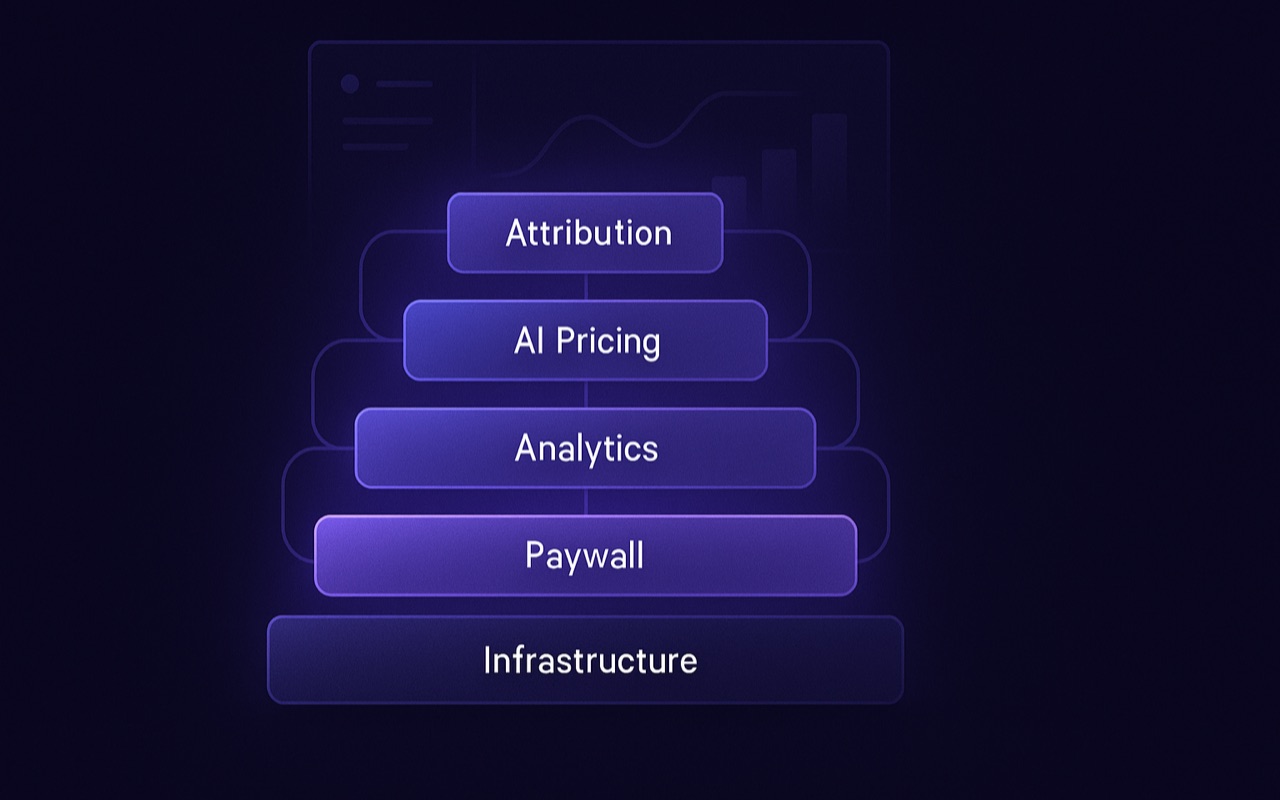
The 5-layer mental model
Before comparing logos, separate the jobs. Almost every "subscription platform" is really a combination of these five layers, and the market shifted in 2025–2026: the infrastructure players absorbed the paywall-builder job, and a new AI-pricing layer emerged on top.
1 · Purchase infrastructure
The SDK that talks to StoreKit and Play Billing: receipts, entitlements, cross-platform sync, webhooks. This is the backend you cannot skip. RevenueCat, Adapty, Qonversion, and Apphud all live here.
2 · Paywall builder + experimentation
No-code remote paywalls you can change and A/B test without an app update. Superwall and Purchasely specialize here; the infra tools now bundle it too.
3 · Subscription analytics
MRR, LTV, cohorts, churn, trial conversion. Bundled into every infra tool; AppsFlyer adds the attribution dimension on top.
4 · AI / dynamic pricing
Predict each user’s intent and serve a personalized price or discount. Monetai is the pure-play here; Superwall’s Demand Score is a feature version.
5 · Attribution / measurement
Tie subscription revenue back to ad campaigns and ROAS. A different category — AppsFlyer leads it. Infra tools forward events to it; they do not replace it.
Comparison at a glance
Pricing below is summarized as of 2026 and changes often — always confirm on the vendor’s own pricing page before committing. "MTR" is Monthly Tracked Revenue (gross, before the store’s 15–30% cut); "MAR" is Monthly Attributed Revenue, which counts only revenue a Superwall paywall generated, not your total.
| Tool | Category | Free tier | Paid model (verify 2026) | Best for |
|---|---|---|---|---|
| RevenueCat | Infra + paywalls | ≤ $2,500 MTR | 1% of tracked revenue (gross) | Default choice, cross-platform |
| Adapty | Infra + native paywall A/B | Until $5K MTR | 1% of revenue | Native paywalls + experimentation |
| Superwall | Paywall specialist | ≤ $10K MAR | 1% of MAR (+ $49/$199 tiers) | Paywall conversion, on top of RevenueCat |
| Qonversion | Infra + analytics | ≤ $10K MTR | 0.6% / 0.8% of revenue | Cost efficiency, refund recovery |
| Purchasely | Paywall (mid/enterprise) | None | ~$1,800/mo flat (sales-led) | Media/enterprise paywalls |
| Apphud | Infra + win-back | ≤ $10K MTR | $49/$59 + per-$1K overage | Churn/win-back, flat-fee economics |
| Nami ML | Enterprise / CTV | None (~100K subs min) | Custom flat | Fortune-100 media, CTV |
| AppsFlyer | Attribution (MMP) | < 12K non-organic installs | ~$0.07 per conversion | UA attribution / ROAS |
| Monetai | AI dynamic pricing | Performance-based | Pay only on incremental revenue | AI personalized discounts on any stack |
The tools, reviewed
RevenueCat — the default full-stack choice
RevenueCat is the market leader and the safe default: open-source SDKs across iOS, Android, Flutter and React Native, unified entitlements that include web as a first-class platform, a rebuilt component-based paywall editor with A/B/n testing, 40+ metrics, and the deepest integration ecosystem in the category. Its 2026 report tracks 115K+ apps and over $16B in revenue, so reliability and docs are best-in-class.
Pricing (verify 2026): free up to $2,500 MTR, then 1% of tracked revenue on Pro. The catch — and the single most common complaint — is that the 1% is on gross revenue *before* the store takes its 15–30%, so the effective rate on your net is closer to ~1.43% at a 30% commission. Some apps move to native StoreKit 2 around 100K+ subscribers to escape it. Best for: any stage, and especially anyone who needs a true cross-platform (web + mobile) source of truth. See our RevenueCat review for the deep dive.
Adapty — native paywalls and strong experimentation
Adapty is the closest head-to-head competitor to RevenueCat and the de facto successor to Glassfy. Its differentiator is a no-code Paywall Builder that renders natively (not in a WebView), so paywalls load faster, plus a strong A/B engine with unlimited variants and early-winner prediction, and AI revenue/LTV prediction up to 12 months that now feeds paywall A/B forecasting.
Pricing (verify — it changed recently): free until $5K MTR (down from $10K; older pages still say $10K), then 1% of revenue, with add-ons like Refund Saver priced separately. The old $99/mo minimum is gone. Reviews flag occasionally outdated docs and some REST API limits. Best for: mobile-first teams that prioritize paywall experimentation and native rendering, and teams migrating off Glassfy. See our Adapty review.
Superwall — the paywall-conversion specialist
Superwall is not infrastructure — it is the most mature paywall experimentation engine on the market. You can test design, copy, price, and even *whether to show a paywall at all*, with holdouts and statistical-significance dashboards. It renders via WebView (slower than native) and includes Demand Score, an AI-pricing feature that scores intent and serves the optimal price to high-intent users while discounting low-intent ones.
Pricing (verify 2026): it charges on MAR — Monthly Attributed Revenue, i.e. only revenue earned *through a Superwall paywall*, not your total. Indie is free up to $10K MAR, then 1% of MAR; Startup is $49/mo + 1% MAR; Scale is $199/mo + 1% MAR (adds Demand Score). The "pay only for what we generate" model is appealing, but remember you still need a backend (RevenueCat is even an investor). Best for: apps whose bottleneck is paywall conversion, especially teams already on RevenueCat. See our Superwall review.
Qonversion — the cost-efficiency value leader
Qonversion is the credible budget pick: full cross-platform SDKs, real-time analytics, a Paywall Builder 2.0, A/B experiments, and Refund Keeper, which auto-responds to Apple refund requests and can cut refunds substantially (App Store only). Its ecosystem and brand momentum are smaller than RevenueCat’s, and the best features sit on the higher tier.
Pricing (verify 2026): free up to $10K MTR; Starter is 0.6% of revenue, Growth is 0.8% (adds A/B testing, Apple Search Ads attribution, Refund Keeper, and a 99.99% SLA). At 0.6% versus the standard 1%, it is the cheapest credible infrastructure with a generous free tier. Best for: cost-conscious growing apps that want infrastructure, analytics, and refund recovery in one place.
Purchasely — deep paywalls, backend-agnostic
Purchasely is among the most powerful no-code paywall and onboarding builders, with multivariable A/B testing on design *and* price, promo codes, win-backs, localization in 20 languages, and "story" onboarding flows. Crucially it is backend-agnostic — it connects to StoreKit, Play Billing, RevenueCat, or your in-house system, so it is a paywall layer, not infrastructure on its own.
Pricing (verify): there is no public self-serve pricing; it is sales-led, and third-party sources put it at roughly $1,800/mo flat (approximate and dated — confirm with sales). That opaque, high entry price rules it out for indies. Best for: mid-market and enterprise teams, especially in media and publishing, that want best-in-class paywalls while keeping their own infrastructure.
Apphud — infrastructure with strong win-back
Apphud offers open-source iOS/Android SDKs, real-time analytics, a visual paywall/flow builder, pricing experiments, and a standout: automatic win-back and churn-reduction flows, plus LTV predictions in beta. It is a smaller company, so the brand and ecosystem are lighter than the leaders.
Pricing (verify 2026): free up to $10K MTR (1 seat), then a hybrid flat-fee + overage model — Pro at $49/mo and Expert at $59/mo, each including some MTR with a per-extra-$1K-MTR charge after. That math can surprise you at higher revenue, but the flat-fee structure can also beat a 1% cut once you scale. Best for: indie-to-mid apps that want infrastructure plus analytics and churn/win-back, where flat-fee economics win over a percentage.
Nami ML — enterprise orchestration, including CTV
Nami ML is built for the enterprise: a no-code paywall and flow builder, A/B and multivariate testing, and exceptionally broad platform coverage — iOS, Android, web, and connected TV (Apple TV, Roku, Fire TV, Google TV, Xbox, Samsung, LG, Vizio). It adds enterprise compliance (SOC 2 Type II, GDPR/CCPA), SSO, audit logs, and a 99.99% SLA.
Pricing (verify): enterprise-only with no public pricing, custom annual contracts based on impression volume, and effectively a minimum of around 100,000+ active subscribers (or a clear one-year path to it). That makes it the wrong tool for indies and startups. Best for: large media, telco, and publishing organizations that need cross-platform — especially CTV — subscription orchestration.
AppsFlyer — attribution, not a backend
AppsFlyer is in a different category entirely: it is the leading mobile measurement partner (MMP). For subscriptions, its ROI360 validates IAP and auto-renew revenue — including pending, refunds, cancellations, taxes, and commissions — to give accurate ROAS and tie the subscription lifecycle back to the acquisition source. It is not a purchase backend and does not replace your infra; the two integrate.
Pricing (verify): free under 12,000 lifetime non-organic installs, then roughly $0.07 per conversion on Growth (third-party estimate), with enterprise rates lower at high volume. It is priced on conversions, not a percentage of revenue, and can get expensive at scale. Best for: apps with real user-acquisition budgets that need to attribute subscription revenue to campaigns. Use it *alongside* your infra, and pick one source of truth to avoid double-counting.
Monetai — the AI dynamic-pricing layer
Monetai is a pure-play AI dynamic-pricing tool that sits *on top of* whatever infrastructure and paywall you already run. Its pitch: predict each user’s purchase intent and serve a personalized discount only to the users who likely need one — designed to focus discounts there rather than on people who would have paid full price, with impact validated via A/B testing. It aims to optimize total revenue (ARPU × conversion rate) with an SDK for React Native, iOS, and Android, plus built-in A/B testing (AI-optimized vs baseline). Disclosure: Monetai is built by HayanMind Inc., the same company behind App Pricing Lab.
Pricing: performance-based with no upfront cost — you pay only when additional revenue is generated. The closest analog is Superwall’s Demand Score, but Monetai is a standalone, performance-priced product focused on autonomous discount-rate optimization. Important: it is a complementary pricing layer, not a replacement for your purchase backend or paywall builder. Best for: teams whose paywall and pricing fundamentals are already solid and who want to add AI personalization on top of an existing stack.
How they fit together: common stacks
Most teams do not pick one tool — they assemble a stack across the layers. A few patterns recur:
- Indie / early stage: RevenueCat (or Qonversion for lower cost) for infrastructure and paywalls on the free tier. Add Superwall later only if paywall conversion becomes the bottleneck.
- Growth / mid stage: RevenueCat or Adapty for infrastructure, AppsFlyer for attribution, and Superwall for paywall A/B. Layer Monetai or Demand Score on top for AI pricing.
- Paywall-led: Superwall + RevenueCat — a very common pairing where Superwall owns the paywall and RevenueCat owns the backend.
- Enterprise / media / CTV: Nami ML or Purchasely for paywalls, AppsFlyer for attribution, and an in-house or RevenueCat backend.
- AI-pricing add-on (any stack): Monetai layered on top of existing infrastructure and paywalls — performance-priced, low integration risk, and complementary rather than a replacement.
How to choose by stage
Pre-launch / indie
Start with RevenueCat (most generous default) or Qonversion (cheapest credible infra). Both have free tiers that cover you well past launch. Do not add a separate paywall or attribution tool yet.
Cost-sensitive growth
If the 1% on gross revenue stings, look at Qonversion (0.6–0.8%) or Apphud’s flat-fee + overage model, which can beat a percentage once you scale. Re-run the math at your real MTR.
Conversion bottleneck
If your funnel is fine but the paywall is not converting, add Superwall on top of your existing backend. It is purpose-built for paywall experimentation and you pay on the revenue it attributes.
Real UA budget
Once you are spending on acquisition, add AppsFlyer for true revenue-to-campaign ROAS. Keep one source of truth for revenue events to avoid double-counting against your infra tool.
Enterprise / multi-platform
If you need CTV, SSO, and SOC 2, Nami ML or Purchasely are the realistic options — both are sales-led and priced for organizations, not indies.
Ready for AI pricing
When paywall, pricing, and retention basics are solid, add Monetai (or Superwall’s Demand Score) to personalize discounts by intent. It is an optimization layer on top of what you already run.
The bottom line
For most teams the honest answer is: pick RevenueCat or Adapty for infrastructure (Qonversion or Apphud if cost or churn flows matter more), add Superwall when the paywall is your bottleneck, add AppsFlyer when you have a real acquisition budget, and add an AI-pricing layer like Monetai once the fundamentals are solid. The right answer changes with your stage — revisit it as you grow.
Once your tooling is in place, the next question is whether your prices are even competitive. See the broader revenue playbook, browse the full Playbook hub, or check live app pricing benchmarks from App Pricing Lab’s daily crawl of 135,000+ apps.