
First, the honest framing: Superwall does one job extremely well and deliberately does not do the rest. It is a no-code paywall builder plus the most mature experimentation engine on the market. It is not purchase infrastructure — it does not manage entitlements, receipts, or cross-platform subscription state on its own. To ship a working app with Superwall, you still need a backend such as RevenueCat or native StoreKit underneath it. Read that sentence twice; it is the single most common misunderstanding about the product.
What it is and who it is for
Superwall lets you build, ship, and test paywalls remotely — without an app update — and then run rigorous experiments on them. You design a paywall in a no-code editor, target it to audiences via campaigns, and split traffic across variants. The team it serves best is the app whose bottleneck is paywall conversion: you already have an infra layer and a product people like, and the lever you most want to pull is "which paywall, shown when, to whom, at what price." It is an especially natural fit for teams already on RevenueCat — which is also, notably, one of Superwall’s investors.
Key features
- No-code paywall editor with campaigns, targeting, audiences, and templates — ship and change paywalls without going through app review.
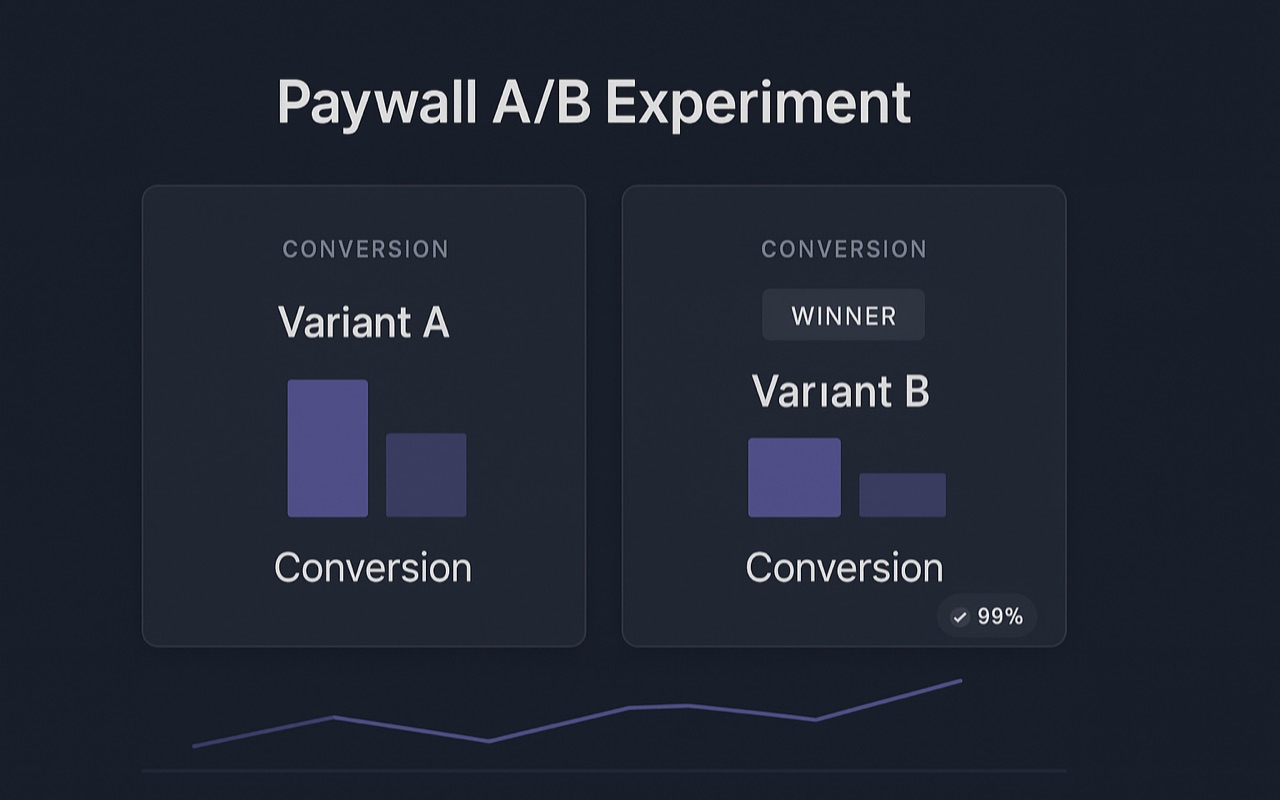
- The most mature experimentation engine in the category. Beyond testing design, copy, and price, Superwall can test whether to show a paywall at all, run holdout groups, and report statistical significance on a dashboard.
- WebView rendering — paywalls are rendered in a web view rather than as fully native UI, which buys flexibility at a small performance cost.
- Surveys and AI localization (on higher tiers) to adapt paywalls across languages and gather user input in-flow.
- Demand Score — an AI pricing feature that scores purchase intent from hundreds of signals and steers high-intent users toward the optimal price while offering discounts to low-intent users.
- Charts, webhooks, and integrations are available on the free tier, which is unusually generous for observability.
Pricing: the MAR model
Superwall’s pricing is its most distinctive feature, and it is easy to misread. It charges on Monthly Attributed Revenue (MAR) — only the revenue that a Superwall paywall actually generated, not your total app revenue. That is a meaningfully different (and friendlier) base than the gross "tracked revenue" that infrastructure tools bill on, because you pay only for the slice Superwall demonstrably influenced.
| Plan | Price | Notes |
|---|---|---|
| Indie | Free ≤ $10K MAR, then 1% of MAR | Generous free tier; pay only on attributed revenue past the threshold |
| Startup | $49/mo + 1% MAR | Adds team features for growing apps |
| Scale | $199/mo + 1% MAR | Adds Demand Score, refund protection, and account management |
| Enterprise | Custom | Volume and bespoke terms |
Pros and cons
Best-in-class experimentation
Nothing else tests paywalls as thoroughly — including the rare ability to test whether to show a paywall at all, plus holdouts and significance reporting.
Pay for what it generates
The MAR model bills only on revenue Superwall’s paywall produced, not your whole business — a fair, aligned-incentive structure.
Layers on your stack
It complements RevenueCat (an investor) rather than competing with it, so adoption is additive, not a migration.
Not infrastructure
You still need a purchase backend underneath. Superwall alone cannot ship a subscription app.
Strengths
If your single biggest lever is paywall conversion, Superwall is hard to beat. The experimentation depth is genuinely category-leading: the ability to test whether to show a paywall, to hold out a control group, and to read significance properly is the kind of rigor that separates teams earning multiples on their experimentation from teams guessing. The MAR pricing aligns Superwall’s revenue with yours — they earn when their paywall earns. And because it layers cleanly on top of existing infrastructure, you can adopt it without ripping out your backend.
Weaknesses
- It is not infrastructure. You still need RevenueCat, StoreKit, or another backend for entitlements and receipts. Budget and plan for two tools, not one.
- WebView rendering is slower than fully native paywalls (the approach Adapty emphasizes). For most apps the difference is small, but it is a real trade-off if paywall load time is sensitive in your funnel.
- Small team. Superwall is a focused, lean company; weigh that against the larger ecosystems of incumbents if vendor scale matters to you.
- Even Superwall is candid about fit. The company has published a piece titled "Why You Probably Shouldn’t Use Superwall," which is a refreshingly honest signal that the tool is not for everyone.
The ideal Superwall user
Superwall fits best when (1) your monetization bottleneck is the paywall itself — not acquisition, not retention plumbing — and (2) you already run, or are happy to run, a separate purchase backend like RevenueCat. If you are pre-paywall, or you want a single tool that also handles entitlements and cross-platform state, start with an infrastructure-first option and add Superwall later, once the paywall becomes your constraint.
2025–2026: what changed
The headline development is Demand Score, Superwall’s AI pricing feature: a model trained on hundreds of signals that estimates each user’s purchase intent, then steers high-intent users toward the optimal price while extending discounts to low-intent users. Pricing moved to the MAR model described above, retiring the old per-conversion scheme. Funding stands at roughly $6M (last known), with RevenueCat among the investors — which helps explain why the two products integrate so cleanly.
Alternatives worth comparing
Superwall is one option in a crowded field. If you want infrastructure plus paywalls in one tool, read our RevenueCat review. If native paywall rendering and a strong A/B engine matter most, see our Adapty review. For a side-by-side of the whole category — infra, paywall builders, analytics, and AI pricing — see the best IAP and subscription tools.
How Monetai’s AI pricing compares to Demand Score
Demand Score is a feature inside Superwall, gated to the Scale tier and tied to Superwall’s paywall. Monetai tackles the same job — personalized, intent-based pricing — but as a standalone, performance-priced layer that sits on top of whatever paywall and infrastructure you already use. It predicts each user’s purchase intent and serves a personalized discount only to users who likely need one — designed to focus discounts there rather than on buyers who would have paid full price, with impact validated via A/B testing. The two are best understood as complementary: Demand Score lives where your Superwall paywall lives, while Monetai is an independent AI-pricing layer you can run across your stack and pay for only when it generates additional revenue. If you are evaluating AI pricing, it is reasonable to look at both rather than assuming one rules out the other.
Curious where your own prices land against the market? Browse live app pricing benchmarks from App Pricing Lab’s daily crawl of 135,000+ apps.