
What Adapty is — and who it is for
Adapty is an all-in-one subscription growth platform for mobile apps. At its core it is purchase infrastructure: an SDK that handles StoreKit and Google Play Billing, receipts, entitlements, cross-platform sync, and webhooks — so you do not write and maintain that brittle plumbing yourself. On top of that it layers a no-code paywall builder, an experimentation engine, and analytics. In the market, it sits as the closest direct competitor to RevenueCat, with a sharper focus on paywall experimentation and native rendering.
It fits mobile-first teams whose growth bottleneck is paywall conversion and who want to test relentlessly without shipping an app update for every change. It is also the natural landing spot for teams that used Glassfy, which shut down at the end of 2024 — Adapty helped migrate those customers and is widely treated as its de-facto successor.
Key features
Adapty's feature set spans the full subscription lifecycle. The pieces that come up most often:
- Purchase SDK — cross-platform handling of StoreKit and Play Billing, receipt validation, entitlements, subscription state sync, and webhooks. The infrastructure layer everything else builds on.
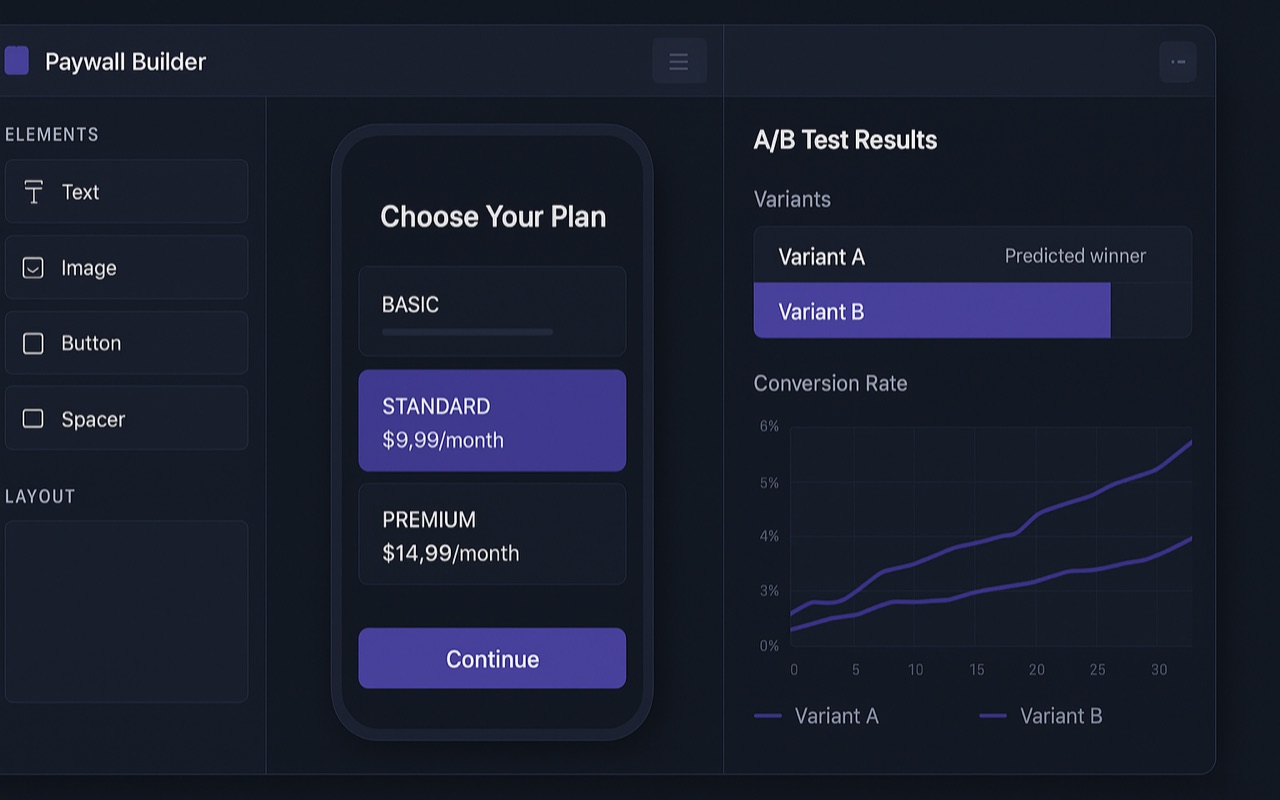
- Native-rendering paywall builder — a remote, no-code editor whose paywalls render natively rather than in a WebView, and can display offline. You change paywalls from the dashboard without an app release.
- Onboarding builder — the same no-code approach extended to onboarding flows, so you can shape the path to the paywall, not just the paywall itself.
- A/B testing engine — custom traffic splits, unlimited variants, and early-winner prediction that flags a likely winner before a test fully concludes.
- Granular analytics — MRR, LTV, cohorts, trial conversion, churn, and revenue breakdowns, designed for slicing rather than just a top-line dashboard.
- AI revenue/LTV prediction — forecasts of lifetime value and revenue up to 12 months out, now extended to forecast paywall A/B outcomes earlier.
- Web SDK — extends entitlements and purchases beyond the app stores to the web.
- Add-ons — Refund Saver (auto-responds to refund requests), UA Tools, and an Apple Ads Manager, each available separately on top of the core platform.
Pricing
Adapty prices on Monthly Tracked Revenue (MTR) with a usage-based model, and the structure changed recently — so treat the numbers below as a snapshot and confirm the live figures on Adapty's pricing page before you commit.
| Tier | Price (as of 2026, verify) | Notes |
|---|---|---|
| Free | $0 until $5K MTR | Newer pricing; older pages still say $10K — verify which applies |
| Paid | 1% of revenue | Kicks in above the free threshold; the previous $99/mo minimum has been removed |
| Enterprise | Custom | Volume / custom terms |
- The free tier covers apps until $5,000 in monthly tracked revenue per Adapty's own 2026 pricing. Note that some third-party listings and older Adapty pages still cite $10K — this changed, so double-check the current figure.
- Above the free threshold, paid usage is 1% of tracked revenue. MTR is generally gross revenue before the store's 15–30% commission, so model your effective rate on net.
- The previous $99/month minimum has been removed, which makes Adapty far friendlier to smaller apps than it used to be — a common past complaint that has been addressed.
- Add-ons are priced separately on top of the 1%: Refund Saver, UA Tools, and Apple Ads Manager each carry their own usage-based fees, so the all-in cost depends on which add-ons you enable.
Pros and cons
Pro · Native paywalls
Paywalls render natively, not in a WebView, so they tend to feel faster and smoother and can show offline.
Pro · Strong experimentation
A mature A/B engine with unlimited variants and early-winner prediction, backed by AI revenue forecasting.
Pro · Generous, simpler pricing
Free until $5K MTR and no more $99/mo minimum lowers the barrier for indie and early-stage apps.
Con · Documentation gaps
Reviews repeatedly flag docs that are inaccurate or out of date, which slows integration.
Con · SDK rough edges
Teams report occasional SDK friction — not a dealbreaker, but expect some debugging time.
Con · REST API limits
The REST API is limited (historical data sits behind webhooks), which can constrain custom reporting.
Where Adapty is genuinely strong
The standout is native paywall rendering. Many competitors draw paywalls in a WebView; Adapty renders them natively, which typically means faster load, smoother feel, and the ability to display offline. For a screen whose entire job is to convert, that responsiveness matters. Pair it with a strong A/B engine — unlimited variants, custom splits, and early-winner prediction so you can call tests sooner — and predictive AI that forecasts LTV and revenue up to a year out, and you have a platform built specifically for teams whose growth lever is paywall experimentation. Adapty is also widely seen as the de-facto successor to Glassfy, having helped migrate that product's customers when it wound down, which lends it credibility with experienced subscription teams.
Where it falls short
The most consistent complaint is documentation: reviewers report docs that are inaccurate or outdated, which makes onboarding slower than it should be for a tool this capable. Teams also mention SDK rough edges — occasional friction during integration — and REST API limits, where historical data lives behind webhooks rather than being easily queryable, constraining custom analytics and reporting. None of these are fatal, but they are real, and worth weighing if you have a small team and limited time to fight tooling. The old knock that Adapty was too pricey for tiny apps has largely been fixed by the new free tier and removed minimum.
Who should use Adapty
Adapty is the right pick if you are a mobile-first team that wants to win on paywall experimentation and values native rendering, and if you want infrastructure and a paywall builder from one vendor rather than stitching two together. It is an especially natural home for former Glassfy customers. If you need the broadest possible cross-platform reach including web as a primary surface, or you mainly want the cheapest credible infrastructure, it is worth comparing alternatives before deciding.
Adapty in 2025–2026
Two things define Adapty's recent trajectory. First, pricing got friendlier: the new free-until-$5K tier and the removal of the $99/month minimum directly address its biggest historical objection from small teams. Second, it pushed AI deeper into experimentation, extending its revenue/LTV prediction into paywall A/B forecasting so teams can act on likely outcomes sooner. On funding, Adapty is best described as modestly capitalized — its last publicly known raise was a seed round of roughly $2.5M (November 2022), with no later Series A surfacing in our research. That is a smaller war chest than its larger rival, which is worth knowing, but it has not stopped Adapty from shipping competitive features.
Alternatives to consider
Adapty is strong, but it is not the only credible choice. Weigh it against the field:
- RevenueCat — the market-leading infrastructure with the deepest integrations, best docs, and strongest cross-platform (web + mobile) support. The default for many teams; its paywalls have historically been less native than Adapty's, though that gap is closing.
- Superwall — a paywall-first specialist with the most mature experimentation, but it is not infrastructure: you still need a backend like RevenueCat or StoreKit behind it.
- See our full comparison of IAP subscription tools for how Adapty stacks up against RevenueCat, Superwall, Qonversion, and others on free tiers, pricing model, and rendering.
Where Monetai fits
Adapty handles the foundation — purchase infrastructure, paywalls, and experimentation — but it is not a dynamic-pricing engine. Once that foundation is solid, the next lever is personalization: charging closer to each user's actual willingness to pay rather than one list price. That is the layer Monetai operates in. It predicts each user's purchase intent and serves a personalized discount only to users who likely need one — designed to focus discounts there rather than on people who would have paid full price, with impact validated via A/B testing. Crucially, it is complementary, not a replacement — Monetai sits on top of whatever subscription infrastructure and paywall you already run, including Adapty. You keep Adapty for the backend and paywall, and add Monetai as the AI-pricing optimization layer if and when per-user pricing is your next bottleneck.