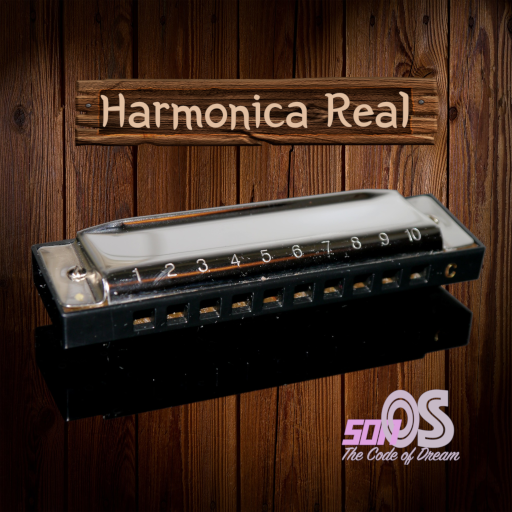
Harmonica Real Price Snapshot
Harmonica Real by sonOS is free to download on the Google Play, with no in-app purchases. It holds a 4.6★ rating from 248 reviews.
Listing last updated: 2025-03-08. Source: public Google Play data, compiled via the App Pricing Lab methodology.
4.6★
248 reviews
50.0K
Installs
Jan 21, 20
Released
2025-03-08
Last Updated
Rankings
| Category | Collection | Rank | Date |
|---|---|---|---|
| GAME_MUSIC | topselling_free | #116 | 2026-03-10 |
Screenshots



About Harmonica Real
The harmonica, also known as a French harp or mouth organ, is a free reed wind instrument used worldwide in many musical genres, notably in blues, American folk music, classical music, jazz, country, and rock. The many types of harmonica include diatonic, chromatic, tremolo, octave, orchestral, and bass versions. A harmonica is played by using the mouth (lips and tongue) to direct air into or out of one (or more) holes along a mouthpiece. Behind each hole is a chamber containing at least one reed. The most common is the diatonic Richter-tuned with ten air passages and twenty reeds, often called the blues harp. A harmonica reed is a flat, elongated spring typically made of brass, stainless steel, or bronze, which is secured at one end over a slot that serves as an airway. When the free end is made to vibrate by the player's air, it alternately blocks and unblocks the airway to produce sound.
Reeds are tuned to individual pitches. Tuning may involve changing a reed's length, the weight near its free end, or the stiffness near its fixed end. Longer, heavier, and springier reeds produce deeper, lower sounds; shorter, lighter, and stiffer reeds make higher-pitched sounds. If, as on most modern harmonicas, a reed is affixed above or below its slot rather than in the plane of the slot, it responds more easily to air flowing in the direction that initially would push it into the slot, i.e., as a closing reed. This difference in response to air direction makes it possible to include both a blow reed and a draw reed in the same air chamber and to play them separately without relying on flaps of plastic or leather (valves, wind-savers) to block the nonplaying reed.
An important technique in performance is bending, causing a drop in pitch by making embouchure adjustments. Bending isolated reeds is possible, as on chromatic and other harmonica models with wind-savers, but also to both lower, and raise (overbend, overblow, overdraw) the pitch produced by pairs of reeds in the same chamber, as on a diatonic or other unvalved harmonica. Such two-reed pitch changes actually involve sound production by the normally silent reed, the opening reed (for instance, the blow reed while the player is drawing).
(https://en.wikipedia.org/wiki/Harmonica)
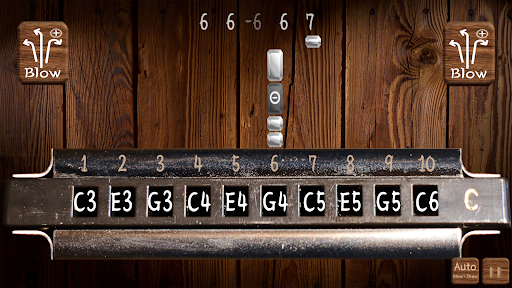
The Harmonica Real is Diatonic Harmonica musical instrument simulation app.
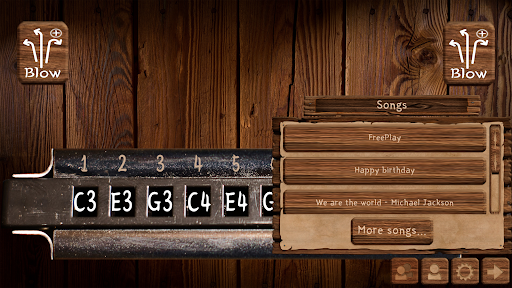
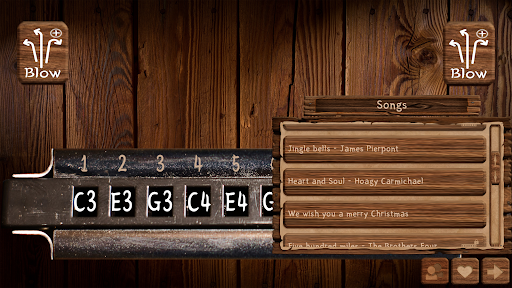
More offline and online songs for practice (With the ability to change speed, transpose, reverb).
Play with 2 modes:
- Normal
- RealTime
You can choose autoplay for listening songs.
Create Music Sheet feature: You can create, save, open your music sheet with 2 instruments: Harmonica and Piano. Export it for playing or sharing to everyone.
Record feature: record, play back and share to your friends.
Reverb feature.
** Songs is updated regularly
Frequently Asked Questions
Is Harmonica Real free?
Yes, Harmonica Real is free to download.
What is the rating of Harmonica Real?
Harmonica Real has a 4.6 out of 5 star rating based on 248 reviews on the Google Play.
Who made Harmonica Real?
Harmonica Real was developed by sonOS. Visit their website at https://sonoscore.com.
Developer
Explore More
Related Music Apps



Share & Embed
Use these badges on your website or blog to link back to this app's data.
Rating Badge
<a href="https://apppricinglab.com/app/google_play/com.sonoscore.harmonica"><img src="https://apppricinglab.com/api/badge/rating?store=google_play&app=com.sonoscore.harmonica" alt="Harmonica Real rating on App Pricing Lab" /></a>Rank Badge
<a href="https://apppricinglab.com/app/google_play/com.sonoscore.harmonica"><img src="https://apppricinglab.com/api/badge/rank?store=google_play&app=com.sonoscore.harmonica" alt="Harmonica Real ranking on App Pricing Lab" /></a>